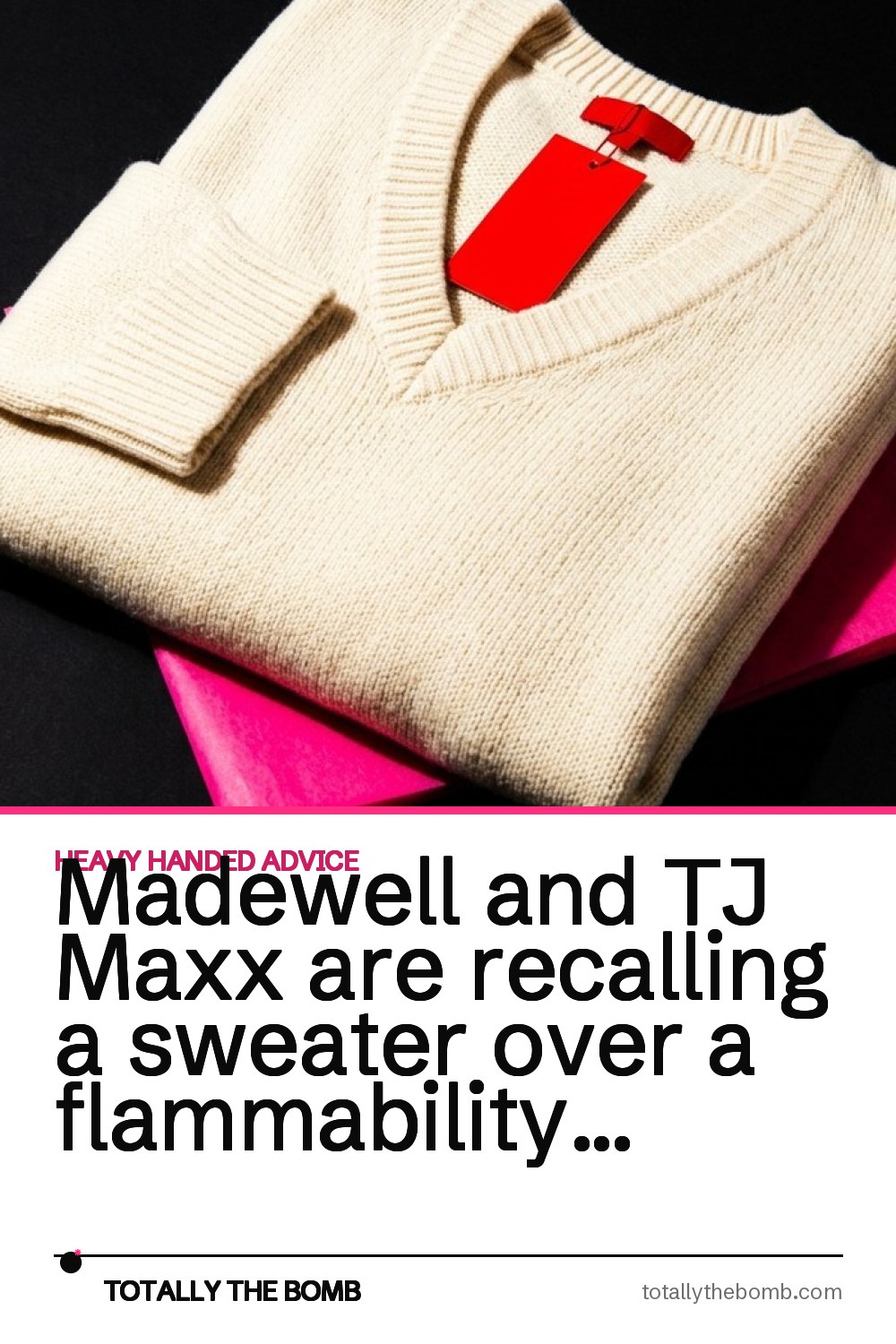
When I think ‘sweater recall,’ I’m not thinking flammability. I’m thinking a button fell off or the sizing was off by two inches. Not ‘this thing could catch fire.’
And yet here we are. The CPSC has flagged the Madewell Double V-Neck Pullover Sweater — sold at both Madewell and TJ Maxx — because it doesn’t meet federal flammability standards. That’s 16 CFR Part 1610 for the nerds keeping track. The rule exists for a reason, and someone didn’t follow it.
No injuries have been reported, which is the one good thing I can say about all of this. But ‘no injuries yet’ is doing a lot of heavy lifting when the risk is literally catching on fire.
What is the Madewell sweater recall actually about?
The Madewell Double V-Neck Pullover Sweater fails to meet federal flammability standards for clothing textiles — specifically 16 CFR Part 1610, which has been on the books for decades. Clothing that doesn’t meet this standard can ignite more easily and burn faster than it should. That’s not a minor labeling technicality. That’s a burn hazard.
The sweater was sold at Madewell retail locations and at TJ Maxx. If you picked it up at either place, you’re in the pool of people who need to check this.
Why does a flammability violation even happen?
Federal flammability standards for clothing textiles aren’t new or obscure — they’ve been around since the 1950s and exist specifically because clothing fires can escalate fast. The CPSC has maintained these standards for a reason, and testing compliance isn’t optional.
This is the part that’s hard to sit with. Madewell is a J.Crew Group brand. It markets itself on quality. TJ Maxx moves an absolutely enormous volume of product through hundreds of stores. Neither of these is a scrappy operation without resources or compliance teams.
So how does a sweater that fails basic flammability testing make it to the sales floor? And then to a second retailer’s sales floor? That’s the question neither brand’s PR statement is going to fully answer.
How did a Madewell product end up at TJ Maxx in the first place?
This is standard retail, honestly. Brands offload overstock and past-season inventory through discount retailers all the time — that’s basically TJ Maxx’s whole business model and nobody’s pretending otherwise.
But when a product moves through that many hands before it hits a rack, accountability gets blurry fast. The brand and the retailer both bear responsibility here. The fact that this cleared both of them and ended up on customers’ bodies anyway is the whole problem.
I’ve thought about this before — in my piece on what happens when product safety corners get cut in the supply chain — and the pattern holds. The rules aren’t new. The testing isn’t complicated. Someone still didn’t do it.
Does this only affect TJ Maxx shoppers?
No — the recall covers units sold at Madewell retail locations too. If you bought this sweater anywhere, it’s worth confirming whether yours is included.
The affected product is specifically the Madewell Double V-Neck Pullover Sweater. Check your closet. Check your dresser drawer. Check the pile of stuff you wore once and never fully put away. You know the pile.
What should you actually do right now?
Stop wearing it. That’s step one and it’s not complicated.
Then go to CPSC.gov and search for the recall to confirm your specific item. The recall database lets you search by brand. Once you’ve confirmed it, contact Madewell directly for a full refund.
Don’t just shove it to the back of the closet and deal with it later. Don’t donate it and make it someone else’s problem. Get the refund. It exists for you to use.
And — this matters more than it sounds — actually following through on a recall is the mechanism that tells brands people are paying attention. A recall nobody acts on is basically a free pass.
Who actually dropped the ball here?
Both of them, and I don’t think that’s an unfair read. Flammability testing is a pre-market requirement. This isn’t something a product should clear manufacturing and multi-retailer distribution without catching.
The ‘we’re cooperating with the CPSC’ statement is going to appear somewhere and it answers exactly nothing about how this got through in the first place. I wrote about the frustrating pattern of brands walking back safety issues after the fact and honestly, nothing has changed.
A recall is only useful if people know about it. Most people don’t go hunting for recall notices on a sweater they bought on a random Tuesday six months ago. That communication gap is on both brands to close — not just this once, but as a standard practice.
But what do I know? I’m just the person who actually reads the recall notices.
Look — I’m not here to tell you to never shop TJ Maxx or Madewell again. I shop both. I will continue to.
But ‘discounted’ doesn’t mean ‘pre-checked,’ and ‘good brand’ doesn’t mean ‘nothing can slip through.’ This is the reminder nobody asked for and everybody needed. Do the five minutes of work. If yours is affected, get your money back.
No injuries reported yet. Keep it that way.
Frequently asked questions
Why is the Madewell sweater being recalled from TJ Maxx?
Has anyone been hurt by the recalled Madewell sweater?
How do I know if my Madewell sweater is part of the recall?
What should I do if I have the recalled Madewell sweater?
If I bought the sweater at TJ Maxx, can I still get a refund?
What is 16 CFR Part 1610 and why does it matter?
Can I just keep the sweater if I remove the flammable parts?