Content note: This post talks about domestic abuse, divorce, and panic. Please take care of yourself while reading — and if today isn’t the day, that’s okay. Come back when you’re ready. If you need support right now, the National Domestic Violence Hotline is available 24/7 at 1-800-799-7233, or text START to 88788.
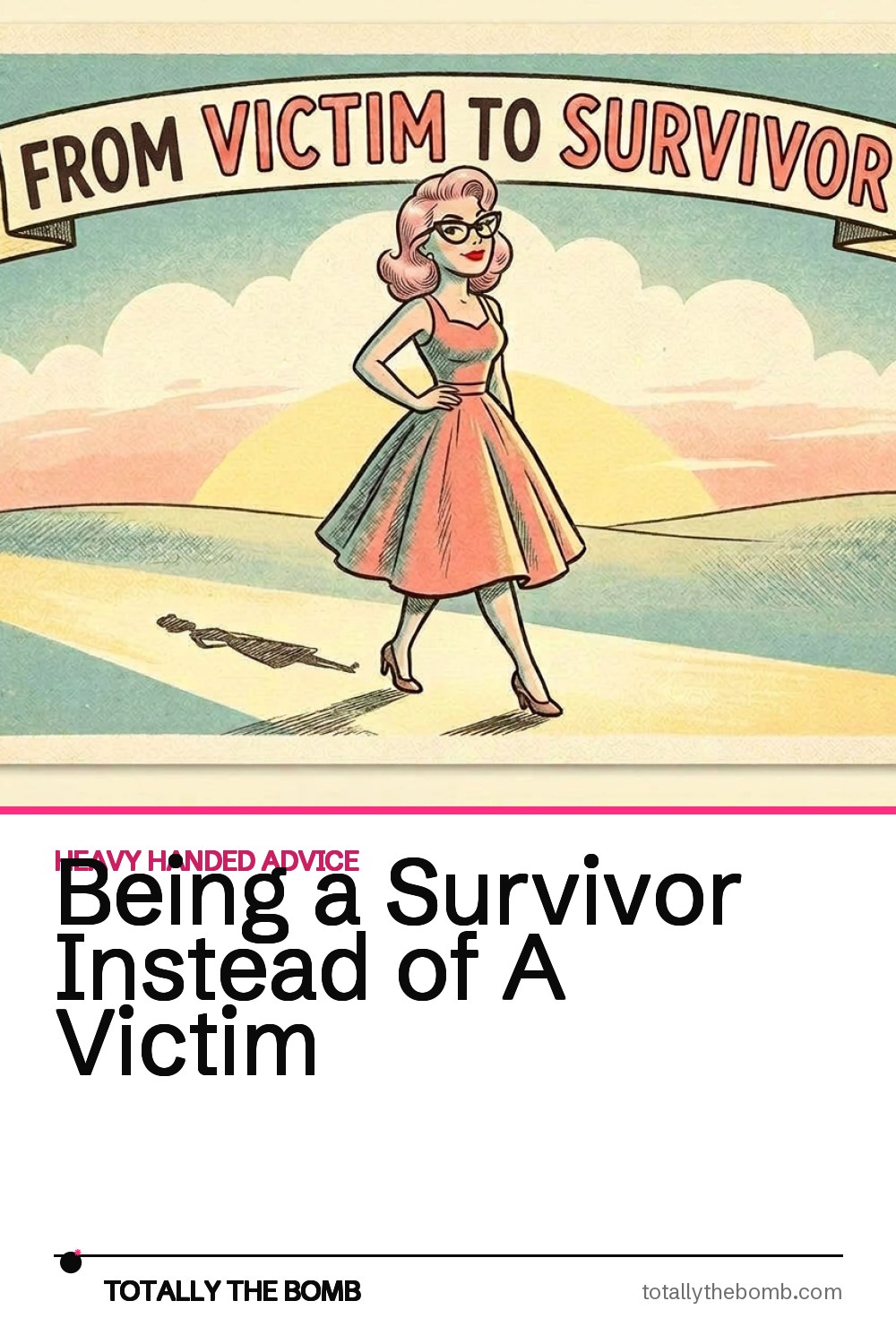
Here’s the thing nobody tells you about abuse: you don’t realize you’re in it until you’re way too far in to easily get out. And by the time you finally do get out, you’ve spent so long being the victim that it’s pretty much the only role you know how to play.
You walk into divorce court a victim. You walk into the criminal trial a victim. You sit across from lawyers, advocates, judges — all the things — and you are the victim, and you are treated like one. And honestly? It makes sense. You’ve been victimized for however many years, and people expect you to behave a certain way because of it.
But the thing is — it ends.

You Can’t Start Surviving Until You’re Out of the Woods
You have to get your life back, and the only way to do that is to take it back yourself. I still don’t totally know what that means most days, but what I do know is that it doesn’t happen until you finally feel safe. You can’t start surviving while you’re still surviving him. You have to know he’s gone — really gone — and then, and only then, can you actually start the process of becoming a survivor.
And when it starts? It’s weird.
At first, you test it the same way a kid tests boundaries — pushing just to see how far you can go before someone gets mad. You start to see how strong you actually are, how much you can handle before you crack. You want to test your limits because you’ve spent the last ten years fighting through the bullshit of a man who abused you and used you, and now you’re suddenly allowed to stand up for yourself. You aren’t walking on eggshells anymore. You aren’t the woman who’s scared of her own shadow. You’re learning what a red flag actually looks like — and more importantly, you’re learning to trust yourself when you spot one.
And then, somewhere in there, the weirdest thing happens: people start coming to you for advice. They want to know how you made it to the other side. And that’s the thing — I didn’t even realize I was on the other side until people started asking me what it was like to be there.
What It’s Like to Be a Survivor
Am I a survivor?
I mean — I’m fully divorced. My ex has multiple protection orders against him. He’s done. I just have to work, solve my own problems, drink my coffee on my porch, and figure out who I am without him in the room. That’s not too much to ask, right?
But sometimes, I am still scared.
Sometimes I remember back to just trying to get through the next hour without upsetting him — and that’s when the panic sets in. It’s a manufactured panic, for sure. It doesn’t make any logical sense. I’m totally fine, until I’m totally not, and then suddenly I want to disappear into my little hobbit hole for the next 5–7 business days and not talk to anyone.
Crowds still feel like too much. Loud rooms still feel like too much. Sometimes my own brain still feels like too much. And I have to remind myself that none of that means I’m broken or going backwards. It just means my nervous system is still catching up to the fact that I’m safe now.
Healing Isn’t Linear (And Anyone Who Says It Is Hasn’t Done It)
And all this to say… healing sucks, and it isn’t linear. It’s not a straight line from victim to survivor. It’s messy. It doubles back on itself. Sometimes it feels like you’re right back where you started, even when you’re not.
I can’t even take it one day at a time most of the time. A whole day is too much. I have to take it ten minutes at a time — sometimes less than that. And that’s not a failure. That’s the work. That’s the actual job of passing through something you weren’t sure you’d survive.
If you’re still in it — or you’re just barely out and you don’t feel strong yet — that doesn’t mean you’re failing. It means your brain and your body are trying to understand a world where you don’t have to be scared all the time. That’s a huge job. Be kind to yourself while you do it.
You are allowed to test your limits. You are allowed to fall apart on the days the panic wins. You are allowed to take up space in your own life again, even if your hands still shake a little when you do it.
You’re not “going back” to being a victim every time you have a bad day. A bad day is just a bad day. It is not a verdict. It is not a backslide. It is not proof that you were never strong to begin with.
You’re a Survivor Figuring Out What Surviving Actually Looks Like
That’s it. That’s the whole thing.
You’re not the victim anymore. You’re not the polished, healed, glowy Instagram version of a survivor either. You’re somewhere in the middle, doing the work — drinking the coffee, locking the door twice just to be sure, sitting on your porch breathing air that nobody is monitoring. You’re learning that surviving doesn’t have to look like winning. It just has to look like waking up tomorrow and trying again.
And that — figuring it out, one shaky, scared, brave ten-minute stretch at a time — is the whole damn thing.