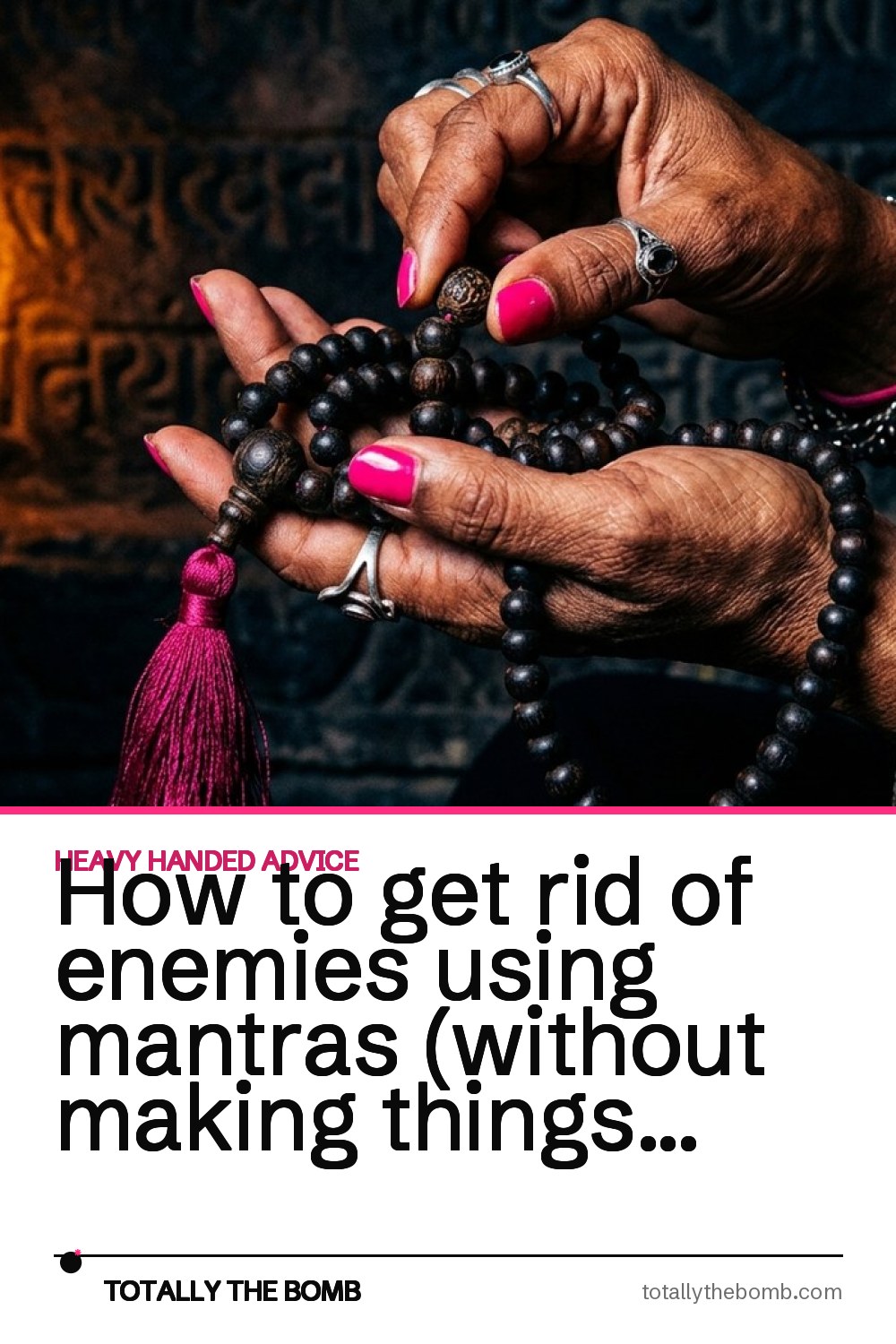
Look, we’ve all had that one person. The one who makes your stomach drop when you see their name pop up. The one you’d genuinely like to just… disappear from your general vicinity forever.
Mantras won’t make anyone disappear — I want to be upfront about that. What they can do is shift your energy, call in protection, and — depending on your belief system — redirect some of that bad juju back toward its source. Which, honestly? Sometimes feels like enough.
Before you start chanting anything, though, there’s some stuff you really need to know. Because mantras aren’t like wishing on a birthday candle. They’re ancient, they’re serious, and they have a way of coming back around.
So what actually is a mantra?
A mantra is a string of Sanskrit words — sometimes just one word, sometimes several — that when repeated out loud, raises your vibration to match your intention. That’s the whole mechanic. Sound, repetition, focus.
In Hinduism specifically, mantras are a way of getting closer to the divine force inside you. They’re woven into yoga and meditation practice because they cut through the noise — the negative energy, the mental clutter, the stuff that keeps you disconnected from your own power. You say the words enough times and something shifts.
That’s not woo for the sake of woo. That’s how mantras have worked for thousands of years — the repetition creates focus, the focus creates intention, the intention creates change.

Do enemy mantras actually work, or is this wishful thinking?
This depends entirely on what you mean by “work.” If you’re expecting your nemesis to spontaneously combust — no. If you’re hoping to feel protected, shift the energy around a toxic situation, and stop being the one absorbing all the damage — genuinely, yes.
The mantras I’m going to walk you through come from real Hindu spiritual practice. They’re not made up for the internet. The Stambhan mantra, the Durga Saptashloki, the Shani mantra — these have roots and history and weight behind them.
But what do I know? I’m just a blogger who finds this stuff fascinating. If you want to go deeper, find a teacher or a practitioner who can walk you through the context properly.
What’s the catch with using mantras against someone?
The Rule of Three. This is the pagan principle that whatever you put out into the world — good or bad — comes back to you threefold. And it maps pretty closely to the karmic principles in Hindu practice too.
So if you chant with a heart full of pure destruction and rage, that energy doesn’t just fly off toward your enemy and vanish. It circles back. Which means you need to get really honest with yourself before you start.
Ask yourself: is this about protection, or is this about revenge? One of those is defensible. The other is going to cost you more than it costs them.
Start with a clear mind. A genuinely clear mind — not “I’ve convinced myself I’m the victim” clear, but actually examined-the-situation clear. That distinction matters more than the words you’re chanting.
The Stambhan Mantra — for suppressing harm
Stambhan comes from the Sanskrit stambhana, which means “to suppress.” This is the mantra you reach for when someone is actively working against you — sending bad energy your way, wishing you harm, maybe even dabbling in something darker.
It’s said to ward off the evil eye, block ill intentions, and neutralize the threat your enemy poses. Not destroy them — neutralize them.
The mantra: Om kreem hoom kreem sarv shatru stambhinee ghor kaalikaayai phat
Recite it 108 times, saying your enemy’s name aloud before you begin. Do this daily until you feel the shift. Each repetition is — according to tradition — like a redirected arrow. Not violence. Redirection.
The Durga Saptashloki Mantra — for invoking Devi’s grace
This one is different in feel. Less aggressive, more devotional. The Durga Saptashloki is drawn from the Devi Mahatmyam — seven sacred poetic verses dedicated to Devi, the primordial force behind the creation of everything.
You’re not commanding anything here. You’re asking. That matters. You’re asking Devi to see what’s been done to you and to render your enemy powerless to continue doing it.
The mantra:
Sarvabaadhaaprashmanah trailokyasyaakhileshwari
Avamev tvayaa kaaryamasmdvairi vinaashnam
Chant this 108 times daily. And — this part is important — stop as soon as you hear news of change. You don’t want to overshoot. This is a deterrent, not a wrecking ball.

The Shani Mantra — for calling in cosmic justice
Shani Dev is the Hindu god of justice. Not vengeance — justice. That framing is everything. Shani rewards good people and holds accountable the ones who cause harm. When you chant this mantra, you’re not asking for destruction. You’re asking to be seen by someone who deals in fairness.
The mantra:
Aum sooryaputraa deerghdehooo vishaalaksh shivpraaye
Manddchaar prasaannnaatmaa peeda haratooo mein shani nilaaanjanaa
Sambhasamm ravee pootramm yammagraajamm chayyyaa maarthandaaa
Sambhoootamm tan namaamee shanaeeshvarammm
Chant this 108 times daily for 30 days. Speak slowly. Enunciate every word. Rushing through it defeats the whole purpose — the sound is the point.
Why 108 times — is that just a random number?
Not remotely. According to Ayurvedic principle, the human body has 108 vital points through which life force flows. So chanting 108 times means each repetition passes through a different vital point in the body — which is a genuinely beautiful way to think about it.
It also connects to the 108 beads on a mala, which is why a lot of people use one to count. If you don’t have a mala, you can check out my earlier look at tools for meditation practice — there are some solid options that won’t break the bank.
The number shows up across Hindu, Buddhist, and yogic traditions in ways that feel less like coincidence and more like something people kept independently arriving at. But what do I know.
What should you actually do before you start chanting any of these?
Honestly, sit with the question of whether you actually need to. Not in a punishing way — in a real way. Is there a practical resolution you haven’t tried? Is the harm ongoing or is this old pain looking for an outlet?
If you’ve thought it through and you genuinely need protection from someone who is actively making your life smaller — then yes. Start. Go slow. Focus your intention on protection and neutralizing harm, not on making them suffer specifically.
And if you’re newer to mantra work and want some grounding context first, I wrote about choosing the right mantra for your specific situation a while back — that’s probably worth reading before you start pointing any of these at a person.
The ancient practice of mantra in the Hindu tradition is genuinely worth respecting. You don’t have to be Hindu to work with these — but you do have to be honest about why you’re picking them up.
Here’s the thing about enemy mantras that nobody wants to say out loud: half the work they do is on you, not on them. You chant 108 times, every day, with focused intention — and somewhere in that process you get clearer about what actually happened, what you actually need, and whether this person still has power over you.
Sometimes the enemy gets neutralized. Sometimes you just stop letting them live rent-free in your head. Honestly? Both count as a win.
Just go in with clean intentions. The universe — or karma, or Shani Dev, or whatever you want to call it — is paying attention.
Frequently asked questions
What is the most powerful mantra to get rid of enemies?
How many times do you chant a mantra for it to work?
Can mantras backfire on you?
What is the Stambhan mantra used for?
Do you have to be Hindu to use these mantras?
What is the Shani mantra and what does it do?
Why is 108 the sacred number in mantra chanting?