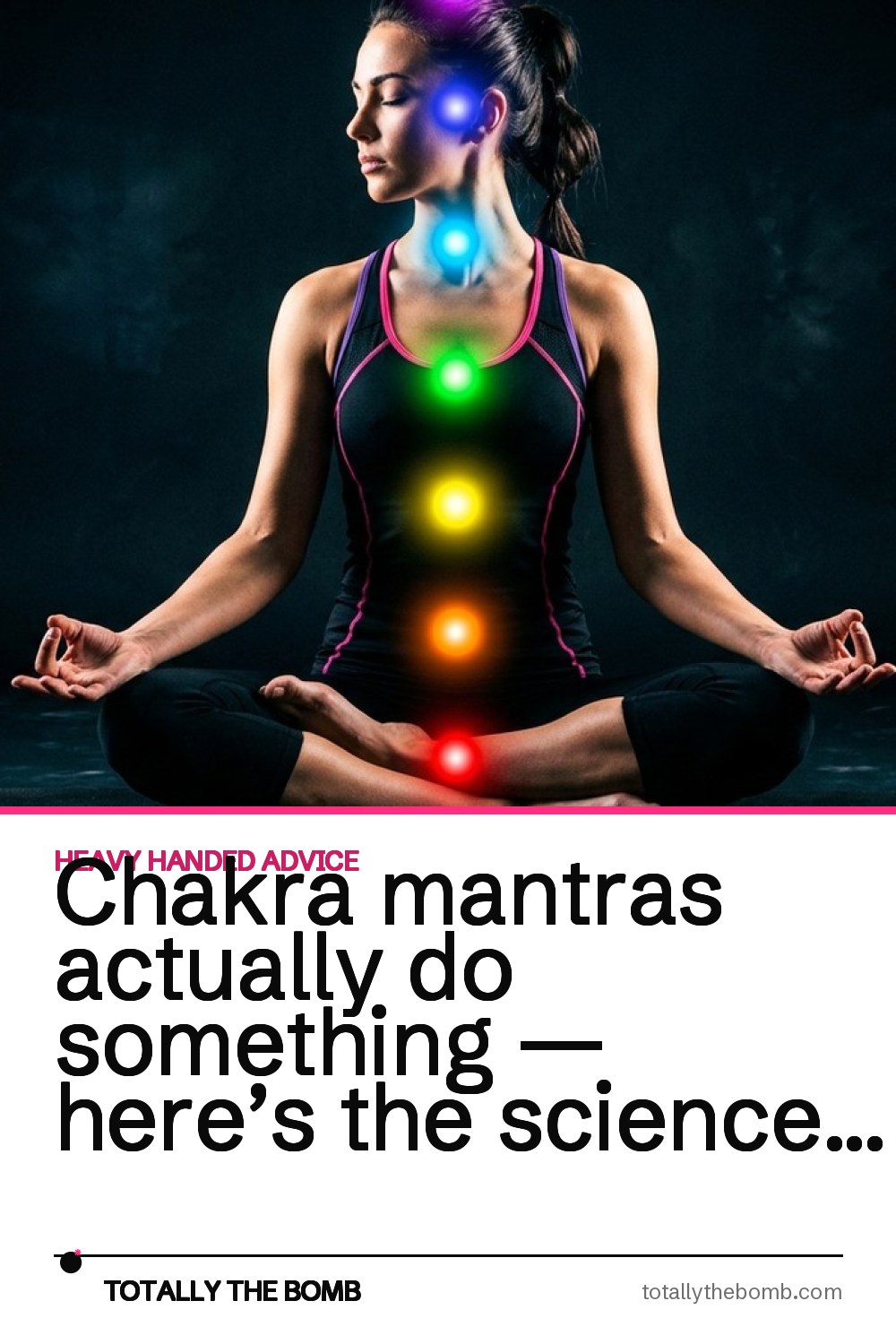
Okay, so I know what you’re thinking. Chakras. Mantras. Very woo-woo. Very ‘woman who burns a lot of incense and has opinions about crystals.’
But here’s the thing — the chakra system isn’t just a spiritual concept someone invented to sell journals. There’s an actual physiological framework underneath it, and the mantras that go with each chakra are doing something real when you use them. Vibration is not nothing.
I’m not here to convince you to redecorate your life around chakra philosophy. I just think if you’re going to try something, you deserve to know why it works — not just that it does.
What even is a chakra?
Chakras are the energy centers of the human body — spinning focal points where physical, emotional, and mental functions all meet. The word itself comes from Sanskrit and literally means “wheel,” derived from “chakravartin,” which described the spinning chariot wheels of rulers. That image actually makes sense when you picture what they’re supposed to do: spin, radiate, keep things moving.
According to Britannica, there are roughly 88,000 chakras in the human body. But seven main ones get all the attention, and for good reason — they map directly onto major nerve clusters and organ systems.
The state of your chakras is believed to connect directly to your physical health, emotional condition, and mental well-being. Block one, and things start to go sideways in that zone.

What are chakra mantras and how do they work?
Chakra mantras are a form of meditation used to activate — or unblock — specific chakras. Each chakra has its own corresponding sound, and the vibration from chanting those sounds is what does the work.
There are two main types you’ll run into. Beej Mantras (also called Seed Mantras) are single-syllable sounds — think “LAM” or “OM” — chanted repeatedly. Prayer Mantras are longer structured phrases or intentions repeated during meditation. Both create vibration. Vibration creates physiological response. That’s not mysticism, that’s acoustics.
If you’ve ever done any mantra meditation practice and felt something shift, that’s probably why.
The 7 chakras — and what goes wrong when they’re blocked
Here’s the rundown. Every one of these has a location, a color, a focus area, and a very specific set of things that go haywire when it’s out of alignment.
1. Root Chakra (Muladhara) — base of the spine, color red, focused on physical identity and stability. Open root chakra = sense of security. Blocked = constipation, arthritis, bladder issues, and that low-grade feeling that nothing is safe.
2. Sacral Chakra (Svadhisthana) — just below the belly button, color orange, tied to creativity and sensuality. When it’s aligned, creative energy flows. When it’s blocked, lower back pain, urinary issues, and a weird kind of creative flatness show up.
3. Solar Plexus Chakra (Manipura) — upper abdomen, color yellow, all about confidence and personal power. A blocked solar plexus shows up as digestive problems — ulcers, heartburn, indigestion — plus a confidence that keeps quietly deflating.
4. Heart Chakra (Anahata) — center of the chest, color green, love and compassion. This one’s connected to heart conditions, weight fluctuations, and asthma when blocked. Also that particular brand of loneliness where you’re around people but feel completely disconnected.
5. Throat Chakra (Vishuddha) — at the throat, color blue, communication. Blocked throat chakra means voice problems, chronic throat issues, and real difficulty saying what you actually mean — or hearing what other people are saying.
6. Third Eye Chakra (Ajna) — between the eyes, color indigo, intuition and imagination. When it’s off, headaches, eye strain, and a general sense that your gut instinct has gone quiet. If you feel like you can’t read a room anymore, check this one.
7. Crown Chakra (Sahasrara) — top of the head, white or violet, intelligence and consciousness. The crown connects to all the other chakras AND to the brain, nervous system, and organs. Open = clarity and something that feels a lot like peace. Blocked = stubbornness, narrow thinking, and that frustrating inability to see past your own point of view.

Is there actual science behind this?
Yes — and this is the part people gloss over because they’re either too skeptical to look or too committed to the mystical framing to want the biology mixed in.
The seven main chakras correspond to the major nerve plexuses along the spine. The root chakra lines up with the sacral plexus. The solar plexus chakra is literally named after the nerve network in that region. The throat chakra maps to the pharyngeal plexus. This isn’t coincidence — it’s a system that ancient practitioners mapped onto the body based on observation, long before Western medicine had the tools to name the same structures.
Research published in Frontiers in Psychology has looked at how chanting and repetitive vocalization affect the autonomic nervous system — specifically the vagus nerve, which runs through several of these same zones. Chanting slows your heart rate, lowers cortisol, and activates the parasympathetic nervous system. Your body genuinely responds.
The neuropsychology connection is real. Focused meditation on specific body regions — which is what chakra work basically is — activates corresponding brain areas. Body awareness practices like this are used in somatic therapy, trauma treatment, and mindfulness-based stress reduction. None of that is accidentally similar to chakra work.
How do you actually use chakra mantras?
You don’t need a certification or a singing bowl (though honestly, singing bowls are great, but what do I know). The basic practice is this: sit quietly, focus your attention on the location of the chakra you’re working with, and chant the corresponding seed mantra either out loud or silently.
For the root chakra, the seed mantra is LAM. Sacral is VAM. Solar plexus is RAM. Heart is YAM. Throat is HAM. Third eye is OM (or AUM). Crown is either silence or a prolonged NG sound.
Do it for a few minutes. Pay attention to what you feel in that area of your body. That’s the whole practice — you don’t need it to be more complicated than that.
If you want to go deeper, there’s a whole world of guided chakra meditations and mantra recordings that can walk you through it. I’d honestly start simple before you go down that rabbit hole, though. In my notes on starting a meditation practice, I talk about how the biggest mistake people make is overcomplicating the beginning.
Should you believe in chakras to benefit from this?
No. That’s kind of the whole point I’m making here.
You don’t have to believe in energy centers to benefit from a practice that slows your breathing, focuses your attention on your body, and creates vibration through sound. The belief layer is optional. The physiology isn’t.
If you’re curious about the spiritual framework — the history of how chakras are described in ancient texts is genuinely fascinating and worth a read. But if you’re just a skeptic who heard that chanting might help with stress and you want to know if it’s worth five minutes of your day, the answer is yes.
Look, I’m not telling you to build a shrine or start color-coding your wardrobe by chakra. I’m saying there’s more going on here than vibes.
The seven chakras map to real places in your body where real things happen. The mantras create real vibration. The meditation creates real neurological responses. You can call it whatever you want — chakra work, somatic awareness, breathwork with sound — the mechanism doesn’t care what you name it.
But what do I know. Try it for a week and see what happens.
Frequently asked questions
What are chakra mantras?
Do chakra mantras actually work?
What is the mantra for each of the 7 chakras?
What happens when a chakra is blocked?
Do you have to be spiritual to use chakra mantras?
What is a seed mantra?
How long should you chant a chakra mantra?